Great Strategies Don’t Fail. Adoption Does.
One of the biggest misconceptions in business is believing that great ideas automatically produce great results. They don’t. Great ideas only create value when people adopt them.
I’ve seen companies invest hundreds of thousands of dollars in implementing new CRMs, redesigning sales processes, rolling out AI tools, launching new pricing models, and restructuring teams.
Six months later? Very little has changed.
The technology works. The strategy makes sense. Leadership is excited. But the organization quietly returns to the way it has always worked.
The conclusion is usually: “The initiative didn’t work.”
I see it differently. The initiative wasn’t the problem. The change management was.
That’s why I believe change management isn’t a supporting activity. It’s one of the most important growth strategies a company can invest in.
Technology Has Changed. People Haven’t.
Over the past decades, we’ve experienced incredible advances. Cloud software. Automation. Artificial Intelligence. Predictive analytics. Revenue Operations. Digital transformation.
Technology has evolved at an incredible pace. People haven’t.
We still resist uncertainty. We still prefer familiar routines. We still question why something needs to change. We still worry about whether we can succeed in a new environment.
That’s human nature.
The companies that understand this don’t simply launch initiatives. They help people successfully navigate them.
A Lesson From Tim Hortons
Recently, I stopped at my local Tim Hortons. Normally, I’m in and out in about five minutes. This visit took almost twenty.
The staff had implemented a new process. You could tell everyone was trying their best. Employees looked frustrated. Customers looked confused. Orders slowed down. The line kept growing.
The issue wasn’t effort. The issue wasn’t attitude. The issue was adoption.
A new process had been introduced, but the organization hadn’t fully worked through how customers and employees would experience the change.
That experience reminded me of something I see inside businesses every week. Companies spend enormous energy designing new processes. Very few put in enough effort to help people successfully adopt them.
Every Growth Initiative Is Actually a Change Initiative
Most leaders don’t think they’re managing change. They think they’re implementing something.
A CRM. A pricing model. A sales methodology. An AI tool. A compensation plan. A customer success framework. A new organizational structure.
But every one of those initiatives asks people to work differently. That means every one of them is fundamentally a change management project.
The sooner leaders recognize that, the higher their chances of success.
Why Most Change Initiatives Stall
After working with organizations across multiple industries, I’ve noticed the same pattern. Leadership spends months planning the solution. Then only days of planning adoption.
That’s backwards.
Planning the change is important. Helping people embrace it is what creates results.
Here are the most common reasons change initiatives lose momentum.
1. People Don’t Understand Why
The first question employees ask isn’t: “How does this work?” It’s: “Why are we doing this?”
Without context, change feels unnecessary.
Explain:
- Why the business needs to evolve.
- What problem is being solved.
- Why now.
- What success looks like.
People support what they understand.
2. Leaders Announce Instead of Engage
Communication isn’t the same as engagement. Sending an email isn’t change management. Holding a kickoff meeting isn’t change management. Posting documentation isn’t change management.
Real engagement creates conversations. It invites questions. It acknowledges concerns. It builds trust.
3. Training Is Mistaken for Adoption
One training session rarely changes behavior.
People learn by:
- Practicing
- Receiving feedback
- Asking questions
- Making mistakes
- Improving over time
Training introduces knowledge. Coaching creates confidence. Those are very different things.
4. Nobody Reinforces the New Behavior
This is where many organizations quietly fail. The initiative launches. Everyone is excited. Then leadership moves on to the next priority.
Employees naturally drift back toward familiar habits. Not because they’re resistant. Because familiar behaviors require less mental effort.
Consistency comes from reinforcement. Not announcements.
5. Success Isn’t Measured
Many companies measure implementation. Few measure adoption. Those aren’t the same thing.
Ask questions like:
- Are people using the new process?
- Is CRM adoption improving?
- Are managers coaching differently?
- Are customers noticing improvements?
- Is productivity increasing?
What gets measured gets improved.
The Five Stages of Successful Change Management
At TeamRevenue, we think about change as a progression rather than a single event.
Stage 1: Awareness
People need to understand: Why are we changing? What happens if we don’t? What’s the opportunity?
Without awareness, change feels arbitrary.
Stage 2: Buy-In
Awareness creates understanding. Buy-in creates commitment. Employees need to answer one important question. “What’s in it for me?”
When people understand how change helps them succeed, resistance decreases significantly.
Stage 3: Enablement
This is where many organizations underestimate the work.
Enablement includes:
- Training
- Documentation
- Coaching
- Job aids
- Practice
- Feedback
People don’t adopt new behaviors because information exists. They adopt them because they’re supported while learning.
Stage 4: Reinforcement
This is where habits form. Managers become incredibly important here.
Recognition. Coaching. Weekly reviews. Celebrating progress. Correcting behavior early.
Change isn’t sustained by policy. It’s sustained through leadership.
Stage 5: Accountability
Eventually the new behavior becomes the standard. Expectations become clear. Measurements become consistent. Coaching continues.
Accountability isn’t punishment. It’s clarity.
Everyone understands what success looks like.
Where Revenue Enablement Fits
This is why I believe Revenue Enablement is one of the most overlooked growth investments. Many companies invest heavily in technology. Few invest equally in helping people succeed with that technology.
Revenue Enablement connects strategy to execution.
It ensures:
- Sales understands new processes.
- Marketing aligns messaging.
- Customer Success reinforces customer outcomes.
- Managers coach consistently.
- Leadership measures adoption.
Without enablement, strategy rarely survives first contact with reality.
AI Is Creating a New Change Management Challenge
Today’s AI conversation sounds remarkably familiar. “We’re implementing AI.” “Everyone should use ChatGPT.” “We’re deploying AI agents.”
That’s exciting. But AI isn’t simply another tool. It’s another change initiative.
Employees need to understand:
- When to use AI.
- When not to use AI.
- What data is appropriate?
- How outputs should be validated.
- What governance exists.
AI adoption without change management creates confusion. AI adoption with enablement creates a competitive advantage.
The CEO’s Role in Change
One of the biggest leadership mistakes is assuming change belongs to Operations or HR. It doesn’t.
Culture follows leadership.
When leaders consistently reinforce new behaviors… Organizations change.
When leaders continue operating the old way… Employees notice immediately.
The fastest way to kill a transformation initiative is for leadership to ignore it after launch. The fastest way to accelerate adoption is for leadership to model the behavior they expect from everyone else.
Change Is Never Finished
Organizations often ask me: “When is the change complete?”
My answer is simple. When the new behavior feels normal.
Not when training ends. Not when software goes live. Not when the project plan closes.
Real transformation happens when people stop talking about the new process because it has simply become the way they work.
Revenue Operations Needs Change Management
Revenue Operations often gets associated with CRM administration, dashboards, and reporting. That’s only part of the picture.
Great RevOps teams understand that operational improvements only create value when people consistently adopt them.
That’s why Revenue Operations and Revenue Enablement belong together. RevOps designs better systems. Enablement helps people succeed inside those systems.
Together, they transform strategy into execution.

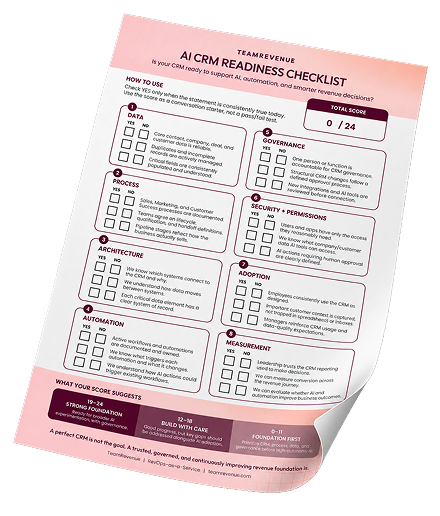
IS YOUR CRM READY FOR AI?
Make sure your CRM foundation is ready. Use the free checklist to uncover gaps before you automate.

Final Thoughts
Business leaders love strategy. They love innovation. They love new technology.
Those things matter. But none of them produce results on their own.
Growth happens when people consistently execute better behaviors.
That’s why change management isn’t an afterthought. It’s the bridge between great ideas and measurable business outcomes.
Technology can change overnight. Processes can be redesigned in weeks. People change one conversation, one coaching session, and one habit at a time.
The organizations that understand this don’t just implement change. They lead it.
And that’s what creates sustainable growth.

WANT THE FULL FRAMEWORK?
Download the free e-book: Driving Business Outcomes with HubSpot. Ten chapters covering the business outcomes every owner should expect from their CRM, from data trust to scaling without breaking.