Every Company Is Using AI. Very Few Are Managing It.
If I walked into your office today and asked one simple question… “How many AI tools are being used inside your company?” Would you know the answer?
Most CEOs wouldn’t. Not because they’re disconnected. Because AI adoption has happened faster than governance.
An employee signs up for ChatGPT. Another experiments with Claude. Marketing tests Gemini. Sales starts using an AI email writer. Customer Success builds prompts for meeting summaries. Someone connects an AI note-taking tool to Zoom. Someone else uploads a spreadsheet into an AI platform.
None of these decisions seems dangerous on its own. But collectively, they create something most organizations haven’t planned for. Shadow AI.
Employees aren’t trying to break the rules. In many organizations, there simply aren’t any rules.
That’s why I believe one of the biggest competitive advantages over the next decade won’t be who uses the most AI. It will be the one who governs AI the best.
AI Isn’t the Problem. Lack of Governance Is.
The conversation around AI usually starts with excitement. “We’re going to automate this.” “We’ll save hours every week.” “Our competitors are already using AI.”
Those conversations are important. But they skip a much more important discussion. How should AI be used inside our business?
Without governance, AI quickly becomes a collection of individual experiments. Everyone works differently. Everyone uses different tools. Everyone creates different prompts. Everyone trusts outputs differently. Eventually, leadership loses visibility into how decisions are actually being made.
That’s not innovation. That’s operational risk.
The Rise of Random Acts of AI
Over the last year, I’ve noticed a pattern across almost every company I speak with. AI adoption starts the same way.
One person discovers a new tool. Another employee hears about it. Someone posts a great result on LinkedIn. Soon, everyone is trying something different.
The organization becomes filled with what I call Random Acts of AI. No shared standards. No approved tools. No governance. No ownership. Just experimentation.
Experimentation is healthy. Unmanaged experimentation isn’t.
At TeamRevenue, we’ve experienced this ourselves. Like many organizations, we were excited about the possibilities. We tested dozens of tools. Compared outputs. Built prompts. Experimented with workflows.
It became clear very quickly that without structure, everyone was creating their own version of AI within the business. That’s when we realized AI didn’t just need adoption. It needed leadership.
The Risks Most SMBs Don’t See
Large enterprises often have legal teams, compliance departments, and information security professionals reviewing AI usage. Most SMBs don’t.
That doesn’t mean the risks disappear. In many ways, they’re greater.
Here are some of the biggest challenges we see.
Customer Data Is Being Shared Without Clear Policies
Employees often upload:
- Customer proposals
- Financial information
- CRM exports
- Sales conversations
- Product documentation
Usually with good intentions. They simply want AI to help.
But without clear policies, organizations may unintentionally expose confidential information. One simple policy can eliminate significant risk.
Everyone Is Using Different AI Tools
Ask your employees which AI platform they use.
You may hear:
- ChatGPT
- Claude
- Gemini
- Copilot
- Perplexity
- NotebookLM
- AI meeting assistants
- AI writing tools
- AI sales assistants
Different tools produce different outputs. Different privacy standards. Different capabilities. Different risks.
Governance starts by understanding what’s already happening.
Nobody Validates the Output
This may be the biggest risk of all.
AI produces remarkably convincing answers. That doesn’t mean they’re correct. Employees naturally trust confident responses.
Without validation, organizations begin making decisions based on information that may be incomplete, outdated, or entirely fabricated.
AI should accelerate thinking. Not replace it.
Brand Consistency Begins to Erode
Marketing uses one prompt. Sales uses another. Customer Success writes emails differently. Every AI interaction sounds slightly different.
Over time, the company’s voice becomes inconsistent. Customers notice.
AI should strengthen your brand, not fragment it.
No One Owns AI
Ask yourself: Who is responsible for AI inside your business? IT? Operations? Marketing? Revenue Operations? The CEO?
If nobody owns AI… Nobody governs AI.
Ownership is the first step toward maturity.
AI Governance Isn’t About Limiting Innovation
Some leaders hear the word governance and immediately think: Rules. Restrictions. Approval processes. Slower innovation.
That’s not what effective governance looks like.
Good governance creates confidence. When employees understand:
- Which tools are approved.
- What data is acceptable.
- How outputs should be reviewed.
- Where AI creates the most value.
They experiment more effectively.
Governance removes uncertainty. It doesn’t remove creativity.
Five Questions Every CEO Should Answer
Before investing in another AI platform, answer these questions.
1. Which AI Tools Are Approved?
Create an approved technology list. This isn’t about limiting choice.
It’s about ensuring your organization understands:
- Security
- Privacy
- Licensing
- Support
- Integration
Standardization reduces risk.
2. What Information Can Employees Share?
This should never be left to individual interpretation.
Define categories such as:
- Public information
- Internal business information
- Customer confidential information
- Financial data
- Intellectual property
Make expectations clear.
3. Who Validates AI Output?
AI should never become the final decision maker. Someone always owns the outcome.
Encourage employees to ask: Does this make sense? Is it accurate? Would I confidently present this to a customer?
Human judgment remains essential.
4. Who Owns AI Governance?
Every successful initiative has an owner. AI is no different.
In many growing organizations, Revenue Operations is well-positioned to lead because it already sits at the intersection of:
- Process
- Technology
- Data
- Sales
- Marketing
- Customer Success
- Enablement
The title matters less than the accountability.
5. How Will Employees Learn?
Most companies assume people already know how to use AI. That’s a dangerous assumption.
Provide:
- Training
- Prompt libraries
- Best practices
- Security guidelines
- Examples
- Ongoing education
Enablement is just as important as governance.
Start Small
One of the biggest mistakes organizations make is believing they need a massive AI strategy before taking action. You don’t.
Start with a simple framework. Assign one owner. Document one policy. Approve a small number of tools. Create basic usage guidelines. Schedule quarterly reviews.
Governance should evolve alongside adoption.
AI Doesn’t Replace Revenue Operations
One of the biggest misconceptions I hear is that AI will eventually manage Revenue Operations. I see the opposite.
AI actually increases the importance of Revenue Operations. Why?
Because AI depends on:
- Clean data
- Consistent processes
- Defined ownership
- Standardized workflows
- Clear accountability
Those are all foundations of Revenue Operations.
AI amplifies operational maturity. It doesn’t create it.
Governance Creates Trust
Employees trust leadership when expectations are clear. Customers trust organizations that protect their information. Leadership trusts AI when outputs are consistent.
Governance builds trust across all three.
Without trust, adoption eventually slows. With trust, innovation accelerates.
The Competitive Advantage Isn’t AI
Eventually every company will have access to similar AI tools. Just like every company eventually had access to CRM systems. And cloud software. And automation.
Technology eventually becomes available to everyone. Execution doesn’t.
The organizations that outperform won’t necessarily be using more AI. They’ll be using AI more intentionally.
They’ll have:
- Better governance
- Better data
- Better enablement
- Better leadership
- Better processes
That’s much harder to copy.

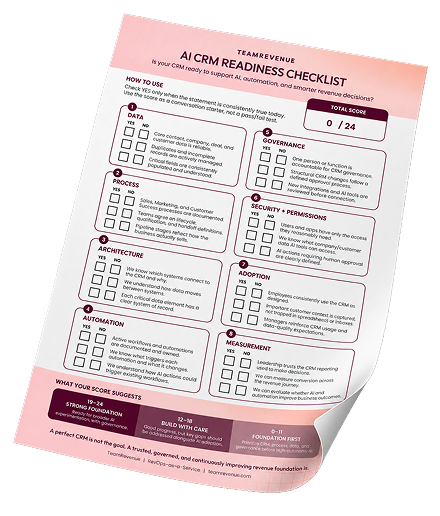
IS YOUR CRM READY FOR AI?
Make sure your CRM foundation is ready. Use the free checklist to uncover gaps before you automate.

Final Thoughts
Artificial Intelligence is one of the most important technologies businesses have ever adopted. But technology alone has never created a competitive advantage.
Leadership does. Process does. Enablement does. Accountability does.
Governance connects all those pieces.
At TeamRevenue, we believe AI shouldn’t exist as a collection of disconnected experiments. It should become another capability inside a well-designed business operating system.
When AI is supported by clear governance, strong Revenue Operations, and continuous enablement, it becomes more than a productivity tool. It becomes a strategic advantage.
Don’t wait until AI is everywhere in your business before asking how it should be managed. Build the rules first. Then scale with confidence.

WANT THE FULL FRAMEWORK?
Download the free e-book: Driving Business Outcomes with HubSpot. Ten chapters covering the business outcomes every owner should expect from their CRM, from data trust to scaling without breaking.