You did not buy HubSpot because you love software. You bought it for results. Here are the 10 outcomes your CRM should be delivering and what to do if it is falling short.

KEY TAKEAWAY: HubSpot is not a database. It is a growth system. But only when it is implemented with a business outcomes lens. The 10 outcomes in this article represent what your CRM should be delivering: from trusted data and a predictable pipeline to clear leadership visibility and a system that scales without breaking. If your CRM is not producing these outcomes, the gap is not in the software. It is in how the system was designed, adopted, and governed.
Your CRM Should Be Producing Results, Not Just Storing Data
Most business owners do not buy HubSpot because they love software. They buy it because they want clearer visibility into performance, a more consistent pipeline, better alignment across teams, and fewer execution breakdowns as the business scales.
HubSpot can deliver all of that. But only if it is implemented with a business outcomes lens. Too many companies treat the CRM as a tool to be configured rather than a system designed around how the business actually needs to operate.
According to a SoftServe study of 750 business leaders, 58% say their organizations make most or all of their major decisions using inaccurate or inconsistent data. That is not a technology failure. It is a systems design failure. The CRM has the data, but it is not structured to produce the outcomes the business needs.
This article outlines the 10 business outcomes every owner should expect from HubSpot, how to recognize when you are falling short, and what to focus on to close the gap. Think of it as a pressure test for whether your CRM is functioning as a true growth system or simply acting as a database.
The 10 Business Outcomes Your CRM Should Deliver
- A single center of truth for customer and revenue data.
Your CRM should be the authoritative system for contacts, companies, deals, and tickets. When someone asks a question about the pipeline, customers, or revenue, the answer should come from a single source. If your team is pulling data from multiple systems and manually reconciling it, the CRM is not doing its job. This starts with treating the CRM as the center of truth from day one and designing every integration to reinforce that role. - Numbers you can trust without a spreadsheet to verify them.
If your leadership team pulls a report and then immediately opens Excel to double-check it, you have a data structure problem. Trusted numbers come from standardized property definitions, clean data models, required fields at the right moments, and quarterly cleanup. When the data going into the system is reliable, the reports coming out of it are too. - Clear visibility into what is actually driving revenue growth.
Marketing generates activity. But can you see which of those activities is creating pipeline and revenue? Your CRM should connect campaigns to deals so you can measure impact, not just volume. That means using campaigns with a consistent structure, tying effort to pipeline influence, and reviewing attribution data monthly to inform budget decisions. - Lead quality and sales focus that are aligned and measurable.
Sales teams struggle when effort is spread evenly across good and bad leads. Your CRM should provide clear lifecycle stages, lead scoring, and segmentation so reps know exactly where to focus. Marketing and sales should work from a shared definition of what makes a lead sales-ready, and that definition should be enforced in the system, not just discussed in meetings. - A predictable and coachable sales pipeline.
Your pipeline should be a coaching tool, not a guessing game. That means deal stages built around buyer commitments, required fields before deals can advance, weekly pipeline inspections, and forecasts used as a management tool rather than just a report. When pipeline discipline is designed into the CRM, forecasting improves, and coaching conversations become productive. - Fewer breakdowns between teams as the business scales.
As companies grow, handoffs break down without clear systems. Your CRM should use workflows and automation to manage handoffs between marketing, sales, and service. But automation should support accountability, not replace it. The goal is to keep humans in the loop for high-stakes steps while letting the system handle the repetitive handoffs that fall through the cracks when done manually. - Focused effort instead of constant busy work.
Busy teams are not always productive teams. Your CRM should use segments, saved views, and behavioral filters to help every team member see exactly what they should be working on and why. When focus is designed into the system, teams naturally spend time on higher-impact work instead of reacting to whatever lands in their inbox. - Visibility into the customer experience after the sale.
Revenue does not end at the close. Your CRM should connect service data to revenue conversations so you can track customer health, identify churn risk early, and create expansion opportunities. Tickets, SLAs, and feedback surveys should feed into the same system where deals and contacts live. When service insights are shared across teams, retention improves and customer lifetime value grows. - Leadership insight without operational overload.
Leaders need clarity, not noise. Your CRM should deliver dashboards built around the decisions your leadership team needs to make, not raw data dumps that require interpretation. That means separating leadership reporting from team activity dashboards, limiting KPI sets to what actually matters, and reviewing performance on a consistent weekly and monthly rhythm. - A system that scales without breaking.
Scaling successfully requires clear structure, effective governance, and intentional integration. Your CRM should have proper permissions, documented integrations, field-level access controls, and quarterly system reviews so the architecture holds up as the business adds people, tools, and complexity. The companies that scale cleanly treat their CRM like infrastructure, not a side project.
How to Use This List as a Diagnostic
Read through the 10 outcomes above and give yourself an honest score for each one. Where is your CRM delivering? Where is it falling short? Where have you not even started?
Most businesses will find they are strong in a few outcomes and weak in several others. That is normal. The value of this list is not to make you feel behind. It is to give you a clear picture of where the gaps are so you can prioritize the right fixes.
Here are a few patterns to watch for:
- If you are weak on outcomes 1 and 2 (center of truth and trusted numbers), start there. Everything else depends on having reliable data.
- If outcomes 4 and 5 (lead quality and pipeline) are the gap, focus on aligning definitions between marketing and sales and building stage discipline into your deal pipeline.
- If outcomes 6 and 7 (team handoffs and focused effort) are slipping, your workflows and segmentation need attention before you add more automation.
- If outcome 10 (scaling) is already causing pain, you have likely outgrown your initial CRM setup and need a system architecture review.
The point is not to fix everything at once. It is to know where you stand and work on the right things in the right order.
What Changes When Your CRM Delivers All 10 Outcomes
When HubSpot is functioning as a true growth system, the shift is felt across the entire business:
- Growth becomes more predictable because leadership can see what is working and make confident decisions.
- Teams become more aligned when everyone works from the same data, definitions, and operating rhythm.
- Execution improves because the system makes the right work obvious and reduces the manual effort that slows people down.
- Leadership can focus on building the future instead of managing the noise, because the system is producing the clarity they need without them having to chase it.
This is the difference between a CRM that stores information and a CRM that drives the business forward. The software is the same. The outcome depends entirely on how it was designed, implemented, and governed.

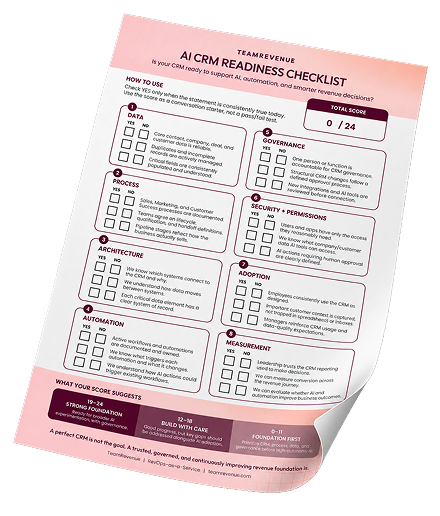
IS YOUR CRM READY FOR AI?
Make sure your CRM foundation is ready. Use the free checklist to uncover gaps before you automate.

The Bottom Line
HubSpot can be the operational backbone of your business. But it will only deliver that result if you treat it as a growth system, not a database.
The 10 outcomes in this article are not aspirational. They are practical. Every one of them is achievable with the right strategy, data structure, governance, and operating discipline.
If your CRM is not producing these outcomes today, the gap is not in the software. It is in the approach. And the good news is that the approach can be fixed. Start with the foundation, work your way up, and hold your system to the same standard you hold the rest of your business.

WANT THE FULL FRAMEWORK?
Download the free e-book: Driving Business Outcomes with HubSpot. Ten chapters covering the business outcomes every owner should expect from their CRM, from data trust to scaling without breaking.
Frequently Asked Questions
At a minimum, you should expect trusted data, clear pipeline visibility, a connection between marketing and revenue, aligned lead definitions, predictable forecasting, smooth team handoffs, focused team effort, post-sale customer visibility, leadership dashboards that drive decisions, and a system that scales without breaking. These 10 outcomes represent what a properly implemented CRM should deliver.
The most common reason is that HubSpot was implemented as a feature configuration project rather than a business outcomes design project. When the CRM is set up without a clear data structure, standardized definitions, integration governance, and an operating rhythm for maintenance, it produces data without producing clarity.
A CRM stores customer data. A growth system uses that data to drive decisions, align teams, and produce predictable revenue. The difference is in how the system is designed, how the data is structured, how teams adopt it, and how leadership uses it. The software is the same. The outcome depends on the approach.
Start with the foundation. If your data is not trusted (outcomes 1 and 2), nothing built on top of it will be reliable. Once data trust is established, move to pipeline and lead quality (outcomes 4 and 5), then team alignment and execution (outcomes 6 and 7), then leadership visibility and scaling (outcomes 9 and 10).
The 10 outcomes apply to any CRM. The specific features and implementation details are referenced to HubSpot because that is the platform we work with most frequently, but the underlying principles of data trust, integration governance, pipeline discipline, and leadership visibility are universal.
Each outcome has a dedicated chapter in the free e-book Driving Business Outcomes with HubSpot by George Albert. The e-book includes the HubSpot features that support each outcome, common pitfalls, best practices, and supporting statistics. You can download it from the TeamRevenue website.