Your CRM should be the single source of truth for your business. When it isn’t, teams lose confidence, data fragments, and growth stalls. Here is how to fix it.

KEY TAKEAWAY: Your CRM being the center of truth means it is the authoritative system for customer, pipeline, and revenue data. It does not replace every tool in your stack. It governs where truth lives. When businesses treat the CRM as an afterthought, systems sprawl, reporting breaks, and leaders lose the ability to make confident decisions. The fix starts with making every tool decision through one lens: how does this integrate with the CRM as the system of record?
You Did Not Buy a CRM Because You Love Software
You bought it because you wanted answers. You wanted to know what your pipeline actually looks like. You wanted to trust the numbers in your Monday morning meeting. You wanted marketing, sales, and service to work from the same page rather than their own spreadsheets.
And yet, for many business owners, the CRM has become the thing nobody trusts. Reports need a footnote. Pipeline reviews turn into arguments about data accuracy. Every quarter, someone builds a new spreadsheet to double-check what the CRM is telling them.
The issue is almost never the software. It is the approach. If your CRM was not built and implemented as the center of truth for your business from day one, every tool, report, and process sitting on top of it will eventually crack.
This article explains what the center of truth actually means in practice, why it matters more than most leaders realize, and what you can do about it if your CRM has quietly drifted into expensive address book territory.
What Does Center of Truth Actually Mean?
Let us start with what it does not mean.
Being the center of truth does not mean replacing every tool in your tech stack with your CRM. Your accounting software still handles billing. Your project management tool still handles delivery. Your help desk still handles support tickets.
What it means is simpler than most people think: your CRM is the authoritative system for customer and revenue data. Other platforms may create data. Others may consume it. But your CRM governs where truth lives.
In practice, that looks like this:
- When someone asks how many deals are in the pipeline, the answer comes from the CRM. Not a spreadsheet.
- When marketing and sales disagree on lead quality, the CRM holds the shared definition and data to settle it.
- When a new tool is being evaluated, the first question asked is: how does this integrate with our CRM as the system of record?
- When a customer has a problem, their full history is visible in one place. Every touchpoint, every deal, every interaction.
This mindset needs to be applied first. Not retrofitted later. Every tool decision, every process design, and every integration should reinforce the CRM’s role as the single source of truth for the business.
Why This Matters More Than You Think
When the CRM is not the center of truth, the problems start small and compound quietly. Then they seem to hit all at once.
Teams Stop Trusting the Data
When different departments track the same information in different ways, nobody trusts what they see. Sales builds its own tracker. Marketing runs parallel reports. Finance asks for a manual reconciliation every month. According to Accenture, 35% of CFOs say their organizations lack access to quality data, which directly undermines insight and decision-making. That is more than one in three finance leaders operating without the clarity they need.
Reporting Becomes a Debate Instead of a Conversation
If your Monday meeting spends more time questioning reports than acting on them, you have a center-of-truth problem. Reports should be trusted by default. When they need a verbal explainer or a caveat before every insight, you are paying for software but not getting the clarity you bought it for.
Decisions Get Slower and Riskier
Leaders who do not trust their data either delay decisions or fall back on instinct. Neither is a growth strategy. Research from Gartner estimates that poor data quality costs organizations an average of $12.9 million per year. That includes wasted time, missed opportunities, and decisions built on information that was wrong from the start.
Scaling Becomes Painful Instead of Natural
At five people, tribal knowledge fills the gaps. At 25, it starts to crack. At 50 or more, it collapses completely. When data is scattered across tools without a governing system, every new hire, channel, and customer segment adds complexity without clarity. The CRM should make growth easier. When it is not the center of truth, growth becomes harder.
Five Signs Your CRM Has Lost Its Role as the Center of Truth
If any of these sound familiar, your CRM has drifted from the center of truth to an expensive afterthought.
- Your team uses spreadsheets to validate CRM reports. If the first step after pulling a report is opening Excel, the CRM is not trusted.
- Third-party tools have become the real source of truth. When your marketing platform or billing tool holds the data people actually rely on, the CRM has been quietly demoted.
- Critical fields are duplicated across systems with no governance. If deal value lives in three places with three different numbers, nobody has a truthful answer.
- Integrations were built without documentation or clear ownership. When nobody knows what syncs, where, or why, data quality depends on luck instead of design.
- Reports need a verbal explanation before they make sense. Good reporting should speak for itself. If it needs context that only lives in someone’s head, the underlying data structure is not right.
How to Establish Your CRM as the Center of Truth
Restoring the CRM to its proper role is not a one-time project. It is an operating principle. Here is a practical framework you can start applying this week.
Define System Ownership for Every Critical Data Field
For every field that drives a decision (deal value, lead source, lifecycle stage, company size), you need to answer one question: which system owns this field?
If the answer is multiple, you have a governance gap. The CRM should own any field tied to customer relationships, pipeline, or revenue. If another system creates the data, define how and when it syncs back to the CRM. No exceptions.
Use Native Integrations Whenever Possible
Native integrations between your CRM and tools like email, calendars, marketing platforms, and billing systems keep data flowing reliably with minimal maintenance overhead. Third-party integration platforms and APIs can fill gaps when native options do not exist, but they should be built intentionally with clear documentation and an assigned owner. Custom integrations without ownership are ticking time bombs.
Design Integrations for Reporting, Not Convenience
It is tempting to sync everything. More data feels like more insight. But syncing excessive data adds noise and risk without adding clarity. Before connecting any tool, ask yourself: what decision will this data help us make? If the answer is unclear, the integration is probably not worth the complexity it introduces.
Document Integration Logic and Owners
Every integration should have a documented purpose, a defined direction of data flow, and a named owner who is accountable for it. Without this, integrations quietly degrade over time as tools update, teams change, and nobody remembers what a particular sync was supposed to do. This is one of the most common sources of mystery data in growing businesses.
Build Quarterly System Governance Into Your Operating Rhythm
Your CRM ecosystem is not something you set up once and walk away from. New tools get added. Old integrations break without anyone noticing. Data requirements shift as the business evolves. Building a quarterly review into your operating rhythm ensures the center-of-truth principle stays intact over time. Treat your CRM architecture the same way you treat your financials: review it regularly and hold someone accountable for it.
What It Looks Like When the CRM Actually Works
When the CRM is functioning as the true center of your business, you will feel it in how the company operates day to day:
- Pipeline reviews become productive because everyone trusts the numbers on the screen.
- Marketing and sales work from shared definitions of lead quality and lifecycle stages, rather than debating them.
- New hires ramp faster because the system tells them what to focus on and where to spend their time.
- Leaders get clear visibility into performance without having to ask someone to manually build a report.
- Scaling feels manageable because the system supports growth rather than fighting it.
This is not theoretical. This is what happens when HubSpot, or any CRM, is implemented with a business outcomes lens rather than a features-first approach. The goal is not more data. The goal is clarity, alignment, and the ability to execute with confidence.

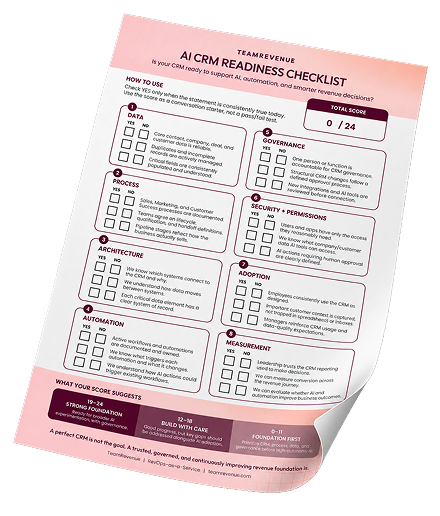
IS YOUR CRM READY FOR AI?
Make sure your CRM foundation is ready. Use the free checklist to uncover gaps before you automate.

The Bottom Line
Your CRM is either the foundation of your growth system or the most expensive tool nobody trusts. There is very little space in between.
If your team is running reports and then immediately second-guessing them, if marketing and sales are working from different data sets, or if you are hiring people faster than your systems can keep up with, the answer is not a new tool. The answer is treating your CRM as what it was always meant to be: the center of truth for your business.
Start with ownership. Strengthen your integrations. Build governance into your operating rhythm. And make every new tool decision with one question front and center: Does this reinforce or undermine our center of truth?

WANT THE FULL FRAMEWORK?
Download the free e-book: Driving Business Outcomes with HubSpot. Ten chapters covering the business outcomes every owner should expect from their CRM, from pipeline predictability to scaling without breaking.
Frequently Asked Questions
It means your CRM is the authoritative system for customer, pipeline, and revenue data. It does not replace every other tool in your stack. Other systems can create or consume data. But the CRM holds the definitive version that the business trusts for reporting and decisions.
The clearest signs are teams using spreadsheets to check CRM reports, different departments tracking the same data in different ways, reports that need verbal context to be understood, and third-party tools becoming the place where people go for the real numbers.
A CRM is the tool. The center of truth is the operating principle. Plenty of businesses have a CRM that stores data, but it is not the system their teams rely on for reporting and decisions. The difference comes down to governance, integration design, and adoption discipline.
HubSpot provides core CRM objects (contacts, companies, deals, tickets), object associations, data sync capabilities, native integrations, and API support. These features allow it to serve as the authoritative system for customer and revenue data when it is implemented with that principle in mind from the start.
At a minimum, once per quarter. Each review should confirm that the integration still serves its original purpose, that data is flowing in the correct direction, that syncs are not creating duplicates or noise, and that the integration still has a documented owner. This should be part of your broader system governance rhythm.
No. The center of truth does not mean your CRM replaces every tool. It means the CRM is the authoritative system for customer and revenue data. Your accounting software, project management tools, and help desk all keep their roles. The key is that they integrate with the CRM rather than competing with it for data ownership.