The Most Expensive Software You’ll Ever Buy Is the One You Hope Will Fix Your Business
I’ve seen it hundreds of times. A leadership team becomes frustrated with inconsistent results. The pipeline isn’t where it should be. Forecasts aren’t reliable. Sales adoption is low. Marketing complains about Sales. Sales complains about Marketing.
Then someone says: “Maybe we need a better CRM.”
Or… “Let’s buy an AI platform.”
Or… “We need a sales engagement tool.”
The assumption is understandable. Technology feels like progress. But technology has one characteristic many leaders overlook: It magnifies what’s already there.
If your process is healthy, technology makes it faster. If your process is broken, technology helps you fail more efficiently.
Process Is Your Competitive Advantage
Ask yourself a simple question. If your CRM disappeared tomorrow, could your sales team still explain your sales process?
Could every salesperson describe:
- Your Ideal Customer Profile
- Qualification criteria
- Sales stages
- Exit criteria
- Handoff to Customer Success
- Forecast methodology
If the answer is no… Your business doesn’t have a technology problem. It has a process problem.
Technology should document your process. Not invent it.
Why Companies Buy Software Too Early
There are usually three reasons.
1. It Feels Like Action
Buying software feels productive. Something is happening. Budgets get approved. Implementation begins. Dashboards get built. Leadership feels momentum.
The problem? Nothing has actually changed.
Software doesn’t improve execution. People do.
2. Vendors Sell Possibility
Every software demo looks amazing. Perfect dashboards. Perfect automation. Perfect reporting. Perfect AI.
What the demo doesn’t show is the work required before any of those outcomes become reality. Software assumes your business already has consistency. Most growing companies don’t.
3. Leaders Want Speed
Growth creates pressure. Pressure creates urgency. Urgency creates shortcuts. Technology often becomes the shortcut.
But shortcuts around the process usually create longer implementation projects later.
What Should Be Designed First?
Before implementing any platform, answer these questions.
Who is our ideal customer?
If Sales and Marketing answer differently, Stop. Fix that first.
How do we qualify opportunities?
Every salesperson should know exactly what qualifies an opportunity. Otherwise, forecasting becomes opinion instead of evidence.
What information matters?
Don’t collect data because software allows you to. Collect information because leadership needs it to make decisions. Simple CRM adoption almost always beats complex CRM design.
How should departments work together?
Technology doesn’t eliminate silos. Leadership does. Map every customer handoff. Marketing to Sales. Sales to Customer Success. Customer Success back to Marketing. This is Revenue Operations.
What behaviors are we trying to reinforce?
Technology shouldn’t replace coaching. It should reinforce good habits. That’s enablement.
AI Is Repeating the Same Mistake
Today, the software conversation has shifted. Replace CRM with AI.
Companies are asking:
- Which AI should we buy?
- Which AI agent should we deploy?
- Which AI platform is best?
Those are interesting questions. They’re just not the first questions.
Instead ask:
- Which process are we improving?
- Which decision are we accelerating?
- Which repetitive task are we eliminating?
- How do we validate AI output?
- Who owns governance?
Without those answers, AI becomes another expensive experiment.
Revenue Operations Connects the Process
This is where Revenue Operations creates value. RevOps isn’t software. It isn’t CRM administration. It isn’t reporting.
Revenue Operations creates alignment across:
- Leadership
- Marketing
- Sales
- Customer Success
- Technology
- Data
- Enablement
Technology becomes one layer inside a much larger operating system. Not the operating system itself.
Five Signs You’re Buying Technology Too Soon
You probably aren’t ready for another platform if:
- Every salesperson has their own process.
- CRM adoption is below 80%.
- Sales stages mean different things to different people.
- Marketing and Sales disagree on lead quality.
- Customer Success doesn’t receive consistent handoff information.
Those aren’t technology problems. There are operational problems.
What Great Companies Do Instead
The highest-performing organizations I’ve worked with rarely begin with software.
They begin with questions.
- How do we want customers to experience our business?
- Which process creates the best outcomes?
- How do we measure success?
- What should be standardized?
- Where does technology remove friction?
Only after those answers are clear do they choose software. Technology supports the operating model. It doesn’t define it.

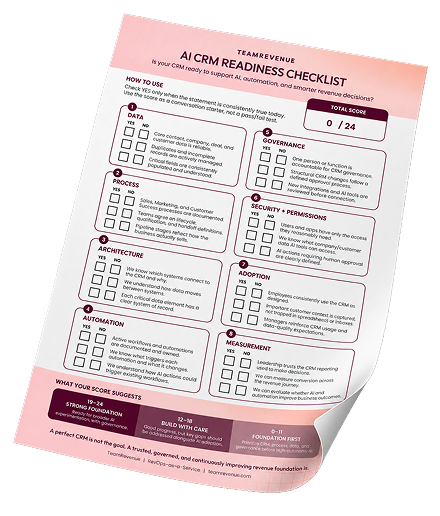
IS YOUR CRM READY FOR AI?
Make sure your CRM foundation is ready. Use the free checklist to uncover gaps before you automate.

Final Thoughts
One of the biggest mindset shifts leaders can make is this: Software doesn’t create discipline. It reveals whether discipline already exists.
The same is true for AI. The same is true for CRM. The same is true for automation.
Great technology amplifies great operations. Weak operations simply become more visible.
If your organization wants predictable revenue growth, start by designing the process. Then build the technology around it. Not the other way around.

WANT THE FULL FRAMEWORK?
Download the free e-book: Driving Business Outcomes with HubSpot. Ten chapters covering the business outcomes every owner should expect from their CRM, from data trust to scaling without breaking.