Is Hiring Really the Answer?
It happens in almost every growing business. Revenue starts to flatten. Pipeline slows. Forecasts become less predictable. Sales misses quota. Leadership gathers around the table, and someone inevitably says:
“We need another salesperson.”
Sometimes that’s exactly the right decision. But more often than not, it’s the most expensive shortcut a company can take.
After working with hundreds of B2B organizations, I’ve noticed a pattern. Companies rarely hire because they’ve reached the limits of a healthy sales system. They hire because the existing system isn’t producing consistent results. There’s a huge difference.
Adding people to a broken system doesn’t fix it. It simply creates more people experiencing the same problems.
Before you approve your next sales hire, ask yourself one question:
Have we fixed the system, or are we trying to hire our way around it?
People Scale Systems. They Don’t Fix Them.
One of the biggest misconceptions in business is believing that talented people can overcome weak systems forever. Great salespeople absolutely make a difference. But even elite performers eventually become frustrated when they work inside an organization with inconsistent processes, unclear expectations, poor handoffs, and unreliable data.
Think about it this way. Imagine hiring ten world-class chefs into a restaurant where:
- Orders are handwritten and often lost.
- The kitchen layout makes no sense.
- Ingredients regularly arrive late.
- Nobody follows the same recipe.
- Inventory is inaccurate.
The chefs aren’t the problem. The kitchen is. Sales organizations work exactly the same way.
The Symptoms Often Point Somewhere Else
Many leaders assume poor sales performance automatically means they need better salespeople. In reality, sales performance is often the result of issues happening elsewhere.
For example:
- Sales complains about lead quality.
- Marketing insists they’re generating enough leads.
- Customer Success hears promises that Sales shouldn’t have made.
- Operations spends its time cleaning CRM data instead of improving processes.
- Finance questions every forecast.
Everyone sees the symptoms. Few investigate the system creating them.
Before Hiring, Audit Your Revenue Engine
Whenever we work with a client considering expanding their sales team, we rarely start with recruiting. We start with diagnosis.
Hiring should be one of the final steps. Not the first.
Here are some of the questions we ask.
1. Is Your Sales Process Clearly Defined?
Can every salesperson explain your sales process the same way? Do they know:
- Exit criteria for every stage?
- Qualification requirements?
- Buying journey?
- Required customer commitments?
If every salesperson follows their own methodology, adding another rep simply introduces another variation. Consistency creates scale.
2. Is Your CRM Helping or Hurting?
Your CRM should make selling easier. Instead, many CRMs become administrative burdens.
Watch your sales team for a day. Do they spend more time updating records than advancing opportunities? Are there dozens of required fields? Are tasks automatically generated that nobody actually completes?
If adoption is low, hiring another salesperson only creates another frustrated CRM user. Fix adoption before expanding the team.
3. Do You Know Why You Win?
Many organizations know their close rate. Few understand why they win.
Review your last twenty closed-won opportunities. Ask:
- Why did customers choose us?
- What patterns exist?
- What objections did we overcome?
- Which industries close fastest?
- Which buyer personas move quickest?
Then compare those answers to your lost opportunities. The insights are usually eye-opening.
4. Do You Know Why You Lose?
This question often produces silence. Companies assume competitors have better pricing. Or stronger relationships. Or a better product.
Maybe.
But assumptions don’t improve performance. Conduct structured win-loss reviews. Look for recurring patterns.
You may discover that your biggest obstacle isn’t competition. It’s inconsistent discovery, poor qualification, or unclear messaging.
5. Is Marketing Feeding the Right Pipeline?
Sales doesn’t need more leads. It needs more qualified opportunities.
Ask yourself:
- Does Marketing understand Sales’ ideal customer profile?
- Are both teams measuring the same definition of a qualified lead?
- Are conversion rates consistent?
Hiring more salespeople while feeding them poor-fit leads rarely improves revenue.
6. Are Customer Hand-Offs Creating Friction?
Growth doesn’t end when the contract is signed. Poor handoffs between Sales and Customer Success often create churn months later.
Review:
- What information gets transferred?
- What expectations were set?
- What business outcomes were promised?
Smooth handoffs improve retention and create better referrals. That’s often a better investment than another salesperson.
7. Are Managers Coaching or Just Inspecting?
Many sales managers spend their time reviewing numbers. Far fewer spend time improving capability.
Great coaching focuses on:
- Discovery
- Qualification
- Objection handling
- Business conversations
- Pipeline strategy
If managers aren’t developing people, hiring more people simply increases management complexity.
8. Is Your Technology Stack Supporting the Process?
Companies often accumulate technology faster than they improve operations.
CRM. Sales engagement. Conversation intelligence. AI. Marketing automation. Forecasting. Proposal software.
Each platform promises efficiency. Together, they often create confusion.
Before adding another salesperson, ask whether your technology stack actually supports a simple, repeatable process.
9. Is AI Solving the Right Problems?
AI has become the newest hiring strategy.
“We’ll automate prospecting.” “We’ll automate proposals.” “We’ll automate follow-up.”
Those are worthwhile goals. But AI should improve an already healthy process.
If your qualification process is inconsistent, AI simply produces inconsistent results faster. Technology should enhance judgment, not replace it.
10. Is Leadership Creating Clarity?
The healthiest revenue organizations have remarkably clear priorities.
Everyone knows:
- The ideal customer
- The sales process
- Success metrics
- Quarterly priorities
- Accountability.
Confusion creates wasted effort. Clarity creates momentum. Leadership owns clarity.
When Should You Hire?
After you’ve improved the system. Not before.
Hiring becomes much more effective when:
- Your sales process is documented.
- CRM adoption is strong.
- Marketing and Sales agree on lead quality.
- Managers coach consistently.
- Customer handoffs are reliable.
- Forecasting is predictable.
- Revenue Operations supports execution.
At that point, every new hire has a much greater chance of succeeding. You’re adding capacity. Not complexity.
Revenue Operations Makes Hiring Smarter
This is where Revenue Operations becomes incredibly valuable. RevOps isn’t just about dashboards or CRM administration. It’s about creating an operating system that allows people to perform at their best.
A healthy Revenue Operations function aligns:
- Leadership
- Marketing
- Sales
- Customer Success
- Technology
- Data
- Enablement
- Accountability
When those pieces work together, hiring becomes far less risky because new employees enter an environment designed for success.
The Cost of Hiring Too Soon
Hiring before fixing the system creates hidden costs that rarely appear on a financial statement.
You increase:
- Recruiting costs
- Onboarding time
- Manager workload
- Technology licenses
- Compensation expense
- Employee frustration
- Voluntary turnover
Worst of all, leadership often concludes they “hired the wrong person.”
In many cases, they hired the right person into the wrong system. That’s a very different problem.

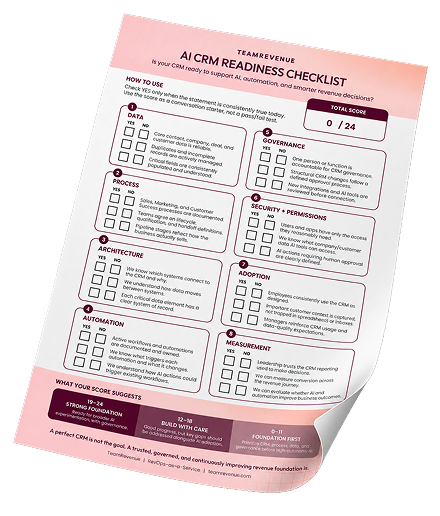
IS YOUR CRM READY FOR AI?
Make sure your CRM foundation is ready. Use the free checklist to uncover gaps before you automate.

Final Thoughts
Hiring talented people will always be important. But talent shouldn’t be your first solution. It should be your multiplier.
The companies that scale predictably don’t rely on heroic individuals to overcome broken processes. They build systems that make average performers better, help great performers thrive, and allow new hires to become productive much faster.
Before you post your next sales job opening, pause and ask one simple question:
If I hired the perfect salesperson tomorrow, would they succeed because of our system, or in spite of it?
The answer may tell you where your next investment should really go.

WANT THE FULL FRAMEWORK?
Download the free e-book: Driving Business Outcomes with HubSpot. Ten chapters covering the business outcomes every owner should expect from their CRM, from data trust to scaling without breaking.