Most growing businesses do not suffer from a lack of tools. They suffer from a lack of trust in their data.
Marketing reports live in one system. Sales forecasts live in another. Finance runs its own spreadsheets. Leadership spends meetings reconciling numbers instead of making decisions.
This is where the concept of the Customer Relationship Management (CRM) system as the central truth becomes critical.
In this article, we will explore why HubSpot must serve as the authoritative system for customer, pipeline, and revenue data, how integrations should support this role, and the common mistakes that can quietly undermine confidence across teams.
This article expands on Chapter 1 of “Driving Business Outcomes with HubSpot: The Business Owner’s Guide to Unlocking the Power of HubSpot”.
What Business Owners Actually Want From a CRM System
Business owners do not invest in HubSpot because they want another database.
They invest because they want:
- Confidence in their numbers
- Faster, better decisions
- Fewer internal debates about whose report is correct
- A clearer view of what is driving revenue growth
When HubSpot is not treated as the center of truth, the opposite happens. Systems sprawl. Data fragments. Trust erodes. Instead of enabling growth, the CRM becomes just another place where data is entered and ignored.
What “Center of Truth” Really Means in Practice
A common misconception is that being the center of truth means HubSpot must replace every other system.
That is not the goal.
Being the center of truth means HubSpot is the authoritative system for customer and revenue data.
Other tools may:
- Create data
- Consume data
- Enhance workflows
HubSpot governs:
- Contacts and companies
- Deals and pipeline stages
- Revenue attribution
- Customer lifecycle status
Every system should either push data into HubSpot or pull from it. Not the other way around.
This mindset must be applied early. Retrofitting it later is far more costly.
A simple guiding question helps maintain discipline:
How does this tool integrate with HubSpot as our system of record?
If there is no clear answer, the tool will likely create more confusion than value.
HubSpot Features That Enable a True Center of Truth
HubSpot is designed to be the center of truth, but it has to be implemented intentionally with this objective in mind.
Key features include:
Core CRM Objects
Contacts, companies, deals, and tickets form the backbone of customer and revenue visibility. These objects must be consistently defined and governed.
Object Associations
Associations connect activities across marketing, sales, and service, enabling leaders to view the entire customer journey without manually stitching reports together.
Native Integrations
HubSpot offers deep native integrations with email, calendars, marketing tools, customer support platforms, billing systems, and more. These integrations reduce friction and increase reliability.
APIs and Custom Integrations
When native integrations are unavailable, HubSpot’s Application Programming Interfaces (APIs) allow custom connections. These should be built deliberately, with clear documentation of ownership and logic.
How Integrations Should Reinforce the Center of Truth
Integrations are where many teams unintentionally break trust in their CRM system.
The issue is rarely the integration itself. It is the lack of governance around it.
Strong integration principles include:
- HubSpot remains the authority for core objects
- Third-party tools do not overwrite critical fields without intent
- Sync logic is documented and owned
- Only data that supports reporting and decisions is synced
Weak integrations often:
- Duplicate critical fields across systems
- Sync excessive data that creates noise
- Operate without a clear owner
- Break silently when tools update
Over time, teams stop trusting reports. Spreadsheets reappear. The CRM system becomes optional.
Common Pitfalls That Undermine Data Trust
Even well-intentioned teams fall into these traps:
- Allowing billing, marketing, or support tools to become the de facto source of truth
- Duplicating key fields across systems without governance
- Building integrations without documentation or ownership
- Syncing everything “just in case” instead of intentionally
- Treating HubSpot as a reporting layer instead of a system of record
Once trust is lost, it is difficult to regain. People stop entering data carefully when they no longer believe it matters.
Best Practices for Establishing HubSpot as the Center of Truth
Business owners who get this right follow a few consistent principles:
- Define ownership for every critical data field
Someone is accountable for accuracy, definition, and change control. - Use native integrations whenever possible
They are easier to maintain and less likely to break silently. - Design integrations to support decisions, not convenience
If the data does not inform reporting or action, it likely does not belong. - Document integration logic and owners
This prevents confusion as teams grow and roles change. - Review integrations quarterly as part of system governance
Your tech stack evolves. Governance must keep pace.
Why This Matters More Than Ever
According to Accenture, “35 percent of CFOs report that their organization lacks access to quality data, hindering insight and decision making”.
This is not a tooling problem. It is a systems and governance problem.
HubSpot can absolutely solve it, but only when treated as the operational backbone of the business, not an afterthought.

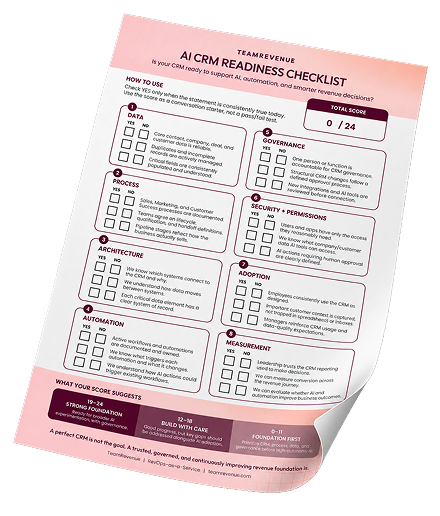
IS YOUR CRM READY FOR AI?
Make sure your CRM foundation is ready. Use the free checklist to uncover gaps before you automate.

Final Thought: Software Does Not Create Clarity. Structure Does.
HubSpot is not a replacement for strategy or leadership. It is an enabler of both when the foundation is in place.
When implemented with clear outcomes, strong governance, and intentional integrations, HubSpot becomes far more than software. It becomes the system that the system leaders rely on to run the business.
Want the Full Guide?
This article expands on just one chapter from “Driving Business Outcomes with HubSpot,” a practical guide designed to help business owners connect CRM activity to real outcomes, such as pipeline clarity, revenue predictability, and confident decision-making.
The e-book walks through:
- Common pitfalls leaders face as they scale
- Best practices that restore clarity and execution
- Outcome-driven ways to use HubSpot across marketing, sales, and service
If this chapter resonated, the full guide will help you pressure test whether HubSpot is truly working as a growth system or simply acting as a database.
Download the complete e-book to continue building clarity, alignment, and confidence across your revenue engine.