Your Revenue Problem Probably Isn’t a Sales Problem
When a company misses its revenue targets, the response is almost predictable. “We need more leads.” “We need better salespeople.” “We need a new CRM.” “We need AI.”
None of these are necessarily bad ideas. The problem is that they’re often solutions to symptoms, not the underlying issue.
After more than 20 years helping B2B companies improve revenue performance, I’ve found that sustainable growth rarely comes from hiring faster, buying more technology, or chasing the latest trend. Instead, it comes from making better leadership decisions.
Revenue doesn’t break overnight. It breaks slowly. One decision at a time.
A process gets skipped. A department becomes disconnected. A new technology gets introduced without adoption. A meeting ends without accountability. An AI tool gets implemented without governance.
Individually, none of these decisions seems significant. Collectively, they create friction across your entire go-to-market strategy.
This is why I believe Revenue Operations (RevOps) is far more than CRM management or reporting. It’s the discipline of aligning leadership, people, process, technology, data, enablement, and accountability into one operating system for growth.
Here are fifteen leadership decisions that quietly undermine revenue growth, and what successful high-growth organizations do differently.
1. Hiring Before Fixing the System
Hiring another salesperson feels productive. It creates momentum. It signals action.
But people don’t fix broken systems. They simply operate within them.
If your sales process lacks consistency, your CRM is underutilized, or your qualification process varies from rep to rep, another salesperson simply introduces more variability.
High-growth companies build systems before they scale headcount.
2. Buying Technology Before Defining the Process
Technology should accelerate a proven process. Too often, companies reverse the order.
They purchase:
- CRM software
- Sales engagement platforms
- Marketing automation
- AI assistants
- Conversation intelligence tools
…hoping technology will define the process for them.
It won’t.
Technology amplifies whatever already exists. If your process is inconsistent, automation simply allows inconsistency to happen faster.
3. Measuring Activity Instead of Business Outcomes
Many organizations celebrate activity. Calls made. Emails sent. Meetings booked. Dashboards updated.
While these metrics have value, customers never buy activity. They buy outcomes.
The healthiest organizations balance operational metrics with business results like:
- Revenue growth
- Pipeline quality
- Customer retention
- Time-to-value
- Lifetime customer value
Measure what actually moves the business forward.
4. Treating AI Like a Shortcut Instead of a Strategy
AI is changing business. There’s no debate about that.
The mistake is believing AI automatically creates better businesses.
Today, nearly every employee has access to AI tools. Few organizations have established:
- AI governance
- Security policies
- Data usage standards
- Validation processes
- Ownership
- Employee enablement
Without governance, AI becomes a collection of random experiments. With governance, AI becomes a strategic advantage.
5. Allowing Departments to Optimize Themselves
Marketing celebrates leads. Sales celebrates revenue. Customer Success celebrates renewals. Operations celebrates efficiency. Finance celebrates margins.
The customer has no experience with any of these departments. They experience one company.
Revenue grows faster when every function is aligned around the customer journey instead of departmental objectives.
6. Rewarding Heroics Instead of Repeatability
Every organization has top performers. That’s healthy.
The danger is building your business around them. Hero cultures often mask broken systems.
High-performing companies document best practices, coach consistently, and build repeatable playbooks so success becomes scalable.
Systems create consistency. Heroes create dependency.
7. Confusing Motion with Progress
Busy organizations often mistake movement for momentum. Calendars are full. Meetings never stop. Projects continue to multiply. Everyone feels productive.
Yet quarterly goals remain unchanged.
The best leadership teams understand that focus is a competitive advantage. Progress requires saying “no” more often than “yes.”
8. Making CRM More Complicated Than It Needs to Be
One of the most common Revenue Operations mistakes is overengineering the CRM.
Leadership wants perfect visibility. So they add:
- More required fields
- More workflows
- More tasks
- More approvals
- More automation
Eventually, adoption drops.
People don’t resist CRM. They resist unnecessary complexity.
Simple processes create better data than complicated ones.
9. Waiting Until Renewal to Demonstrate Customer Value
Customer Success shouldn’t prove value once a year. Customers should experience measurable value every month.
When organizations continuously reinforce business outcomes, renewals become much easier.
Great Customer Success begins long before renewal conversations begin.
10. Prioritizing Everything
If everything becomes urgent… Nothing actually is.
One of leadership’s greatest responsibilities is deciding what not to do.
The fastest-growing companies I’ve worked with don’t necessarily execute more initiatives. They execute fewer initiatives exceptionally well.
Focus compounds. Distraction compounds too.
11. Assuming Communication Equals Adoption
Leadership announces a new process. Everyone attends training. The rollout is considered complete.
Then three months later… Nothing changed. Why?
Because adoption requires reinforcement. Real change management includes:
- Coaching
- Feedback loops
- Accountability
- Measurement
- Continuous improvement
Technology implementation is easy. Behavior change is leadership.
12. Using Discounts to Solve Positioning Problems
Discounting often feels like the fastest way to win business. In reality, it usually exposes a messaging problem.
When customers fully understand the value you create, price becomes only one part of the decision.
Organizations with strong positioning compete on outcomes. Not discounts.
13. Treating Meetings as Decision Sessions Instead of Accountability Sessions
Most leadership teams make plenty of decisions. Execution is where businesses struggle.
Every important discussion should answer three questions:
- Who owns this?
- When will it be completed?
- How will success be measured?
Without accountability, meetings simply create more meetings.
14. Optimizing Departments Instead of Customer Journeys
Customers don’t care where Marketing ends. Or where Sales begins. Or where Customer Success takes over.
They care about one seamless experience.
Revenue Operations exists to eliminate the friction customers shouldn’t have to experience.
Every handoff is either building trust or creating friction.
15. Believing Revenue Is Sales’ Responsibility
This may be the most expensive leadership assumption of all.
Revenue is not produced solely by Sales.
Revenue is influenced by:
- Leadership
- Marketing
- Sales
- Customer Success
- Operations
- Finance
- Technology
- Data
- Enablement
Every decision impacts revenue. Which means revenue is ultimately a leadership responsibility.
The CEO owns alignment. Alignment creates execution. Execution creates growth.
The Pattern Most Leaders Miss
Notice something interesting?
None of these leadership decisions seems catastrophic. That’s exactly why they’re dangerous.
Revenue systems rarely fail because of one massive mistake. They fail because of dozens of small compromises that accumulate over time.
One disconnected department. One poorly implemented process. One technology was purchased without adoption. One initiative was added without removing another. One meeting without accountability.
Eventually, friction becomes normal. Growth slows. Forecast accuracy declines. Customer experience becomes inconsistent.
And leadership begins searching for another tool to solve what is actually an operating system problem.
Revenue Operations Is About Alignment, Not Administration
Many organizations still think Revenue Operations is simply CRM management. Or reporting. Or dashboard creation.
That’s selling RevOps short.
At TeamRevenue, we believe Revenue Operations is the operating system that connects strategy with execution.
It aligns:
- Leadership
- People
- Process
- Technology
- Data
- AI Governance
- Revenue Enablement
- Accountability
When those elements work together, growth becomes more predictable. Forecasts improve. Customers have a better experience. Teams collaborate more effectively. Technology delivers a greater return on investment.
Most importantly, the business becomes easier to scale because success is driven by systems instead of heroic effort.

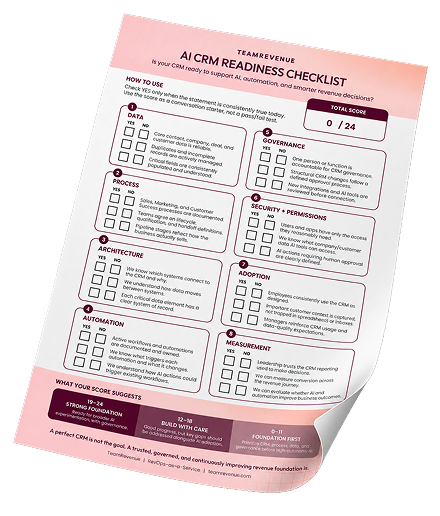
IS YOUR CRM READY FOR AI?
Make sure your CRM foundation is ready. Use the free checklist to uncover gaps before you automate.

Final Thoughts
Every growing company eventually reaches a point where adding more people, more software, or more meetings no longer produces better results.
That’s usually the moment leaders realize they don’t have a talent problem. They don’t have a technology problem. They have an alignment problem.
The organizations that outperform over the next decade won’t simply adopt more AI or buy more software. They’ll build better operating systems.
Because predictable revenue isn’t created by isolated departments. It’s created when leadership intentionally designs a business where every function moves in the same direction.
That’s not just Revenue Operations. That’s how great companies grow.

WANT THE FULL FRAMEWORK?
Download the free e-book: Driving Business Outcomes with HubSpot. Ten chapters covering the business outcomes every owner should expect from their CRM, from data trust to scaling without breaking.