AI Isn’t Replacing Revenue Operations. It’s Making It More Important.
If you spend any time on LinkedIn, you’d think AI is about to replace entire departments. Sales. Marketing. Customer Success. Operations. Even leadership.
The headlines are bold. The demos are impressive. The possibilities are exciting.
But after spending the last year helping clients implement AI into their businesses, I’ve come to a different conclusion.
AI doesn’t eliminate the need for Revenue Operations. It magnifies it.
Because AI isn’t a strategy. It’s an accelerator. And what it accelerates depends entirely on the operating system underneath it.
If your business runs on disconnected processes, inconsistent data, and unclear accountability, AI will simply help you create bad outcomes faster.
If your business runs on aligned people, well-designed processes, clean data, and disciplined execution, AI becomes one of the greatest competitive advantages you’ll ever adopt.
That’s why I believe Revenue Operations is evolving. It is no longer just about CRM administration or reporting. It’s becoming the operating system that connects people, process, technology, data, AI, and accountability.
Revenue Operations Has Outgrown the CRM
Ask ten executives what Revenue Operations means, and you’ll probably hear answers like: “It’s our HubSpot administrator.” “They build reports.” “They manage Salesforce.” “They own dashboards.”
Those are all valuable activities. But they’re not Revenue Operations. They’re outputs of Revenue Operations.
RevOps isn’t about software. It’s about alignment.
It’s the discipline of ensuring every part of your revenue engine works together toward a common goal.
Marketing. Sales. Customer Success. Leadership. Finance. Technology. Data. Enablement.
When those functions operate independently, growth becomes unpredictable. When they’re aligned, growth becomes repeatable.
AI Exposes Operational Weaknesses
One of the biggest misconceptions about AI is that it fixes broken businesses. It doesn’t. It exposes them.
Imagine asking AI to forecast your revenue.
If your CRM data is incomplete… The forecast won’t improve.
If sales stages are inconsistent… The forecast won’t improve.
If qualification is subjective… The forecast won’t improve.
The AI isn’t failing. It’s working with what you’ve given it.
The same is true for:
- AI-generated proposals
- Customer support agents
- Marketing content
- Sales outreach
- Forecasting models
- Executive reporting
AI can only perform as well as the operational foundation supporting it.
The New Role of Revenue Operations
Traditionally, RevOps focused on improving operational efficiency. Today, it must also answer entirely new questions.
For example: How should AI fit into our sales process? Which tools should employees use? How do we protect customer data? Who validates AI-generated content? How do we measure adoption? How do we maintain brand consistency?
These aren’t IT questions. They’re operational questions.
And that’s exactly where Revenue Operations creates value.
Revenue Operations Is Becoming the Business Operating System
At TeamRevenue, we think about Revenue Operations differently. Not as a department. Not as a CRM function. But as the operating system for revenue.
Every successful operating system connects multiple components together.
Revenue Operations should connect:
- Leadership strategy
- Revenue goals
- Marketing execution
- Sales execution
- Customer Success
- Technology
- CRM
- AI
- Enablement
- Accountability
- Data
- Measurement
When one layer changes… Every connected layer should evolve with it.
That’s what operating systems do.
AI Doesn’t Replace Leadership
One of the biggest mistakes organizations make is assuming AI will remove the need for leadership. In reality, leadership becomes even more important.
Someone still needs to decide: What problems are we solving? Which processes matter? How should AI be used? What outcomes define success? Who owns the result?
AI produces recommendations. Leadership makes decisions.
Those aren’t the same thing.
The Six Pillars of Modern Revenue Operations
As AI becomes part of everyday business, I believe Revenue Operations should focus on six interconnected pillars.
1. Strategy
Everything begins here.
Revenue Operations should ensure every department understands:
- Business objectives
- Growth priorities
- Customer strategy
- Revenue goals
Without strategic alignment, optimization happens in silos.
2. Process
Technology should reinforce process. Not replace it.
Document:
- Customer journeys
- Sales stages
- Qualification
- Customer handoffs
- Service delivery
AI becomes dramatically more valuable when the underlying process is already healthy.
3. Technology
Technology should reduce friction. Not create it.
That means regularly asking: Does this platform simplify work? Or add complexity?
Every technology decision should improve execution.
4. Data
AI has made data quality more important than ever.
Poor CRM adoption. Duplicate records. Missing information. Inconsistent fields.
These aren’t administrative issues anymore. They’re strategic risks.
Good AI depends on good data.
5. Enablement
Technology adoption doesn’t happen automatically.
People need: Training. Coaching. Documentation. Practice. Feedback.
This is why Revenue Enablement should become inseparable from Revenue Operations.
Designing systems is only half the work. Helping people succeed inside those systems creates the results.
6. Accountability
Execution is where growth either happens or stalls.
Every initiative should answer: Who owns it? How is success measured? When is it reviewed? What happens if adoption declines?
Accountability keeps strategy alive long after kickoff meetings end.
The Future Belongs to Connected Businesses
The organizations winning over the next decade won’t necessarily have the biggest AI budgets. They’ll have the strongest operational discipline.
They’ll connect: Leadership. Technology. AI. People. Process. Customer experience. Measurement.
Instead of optimizing departments… They’ll optimize systems.
Why The BOS™ Fits Naturally
This evolution is one of the reasons we created The BOS™ (Business Operating System).
As organizations become more complex, leaders need more than software. They need a way to align the entire business around execution.
A modern operating system should answer questions like: What are our priorities? Who owns them? What metrics matter? How do meetings drive accountability? How does AI fit into our workflows? How do we measure progress? How do we maintain alignment as we grow?
That’s the role of an operating system.
Not another dashboard. Not another spreadsheet. Not another AI tool.
A framework that helps the entire organization execute consistently.
Stop Thinking About Departments
One of the biggest mindset shifts leaders need to make is this:
Customers don’t experience departments. They experience businesses.
They don’t know where Marketing ends. Or Sales begins. Or Customer Success takes over.
They simply expect one consistent experience.
Revenue Operations exists to create that consistency. AI should strengthen it. Not fragment it.
The Competitive Advantage Isn’t AI
Eventually every company will have access to similar AI tools. Just as every company eventually gained access to CRM systems, cloud software, automation, and analytics.
Technology always becomes more accessible. Execution doesn’t.
Execution remains a leadership capability.
The businesses that outperform won’t simply adopt AI faster. They’ll govern it better. Enable it better. Measure it better. Align it better.
That isn’t an AI advantage.
That’s a Revenue Operations advantage.

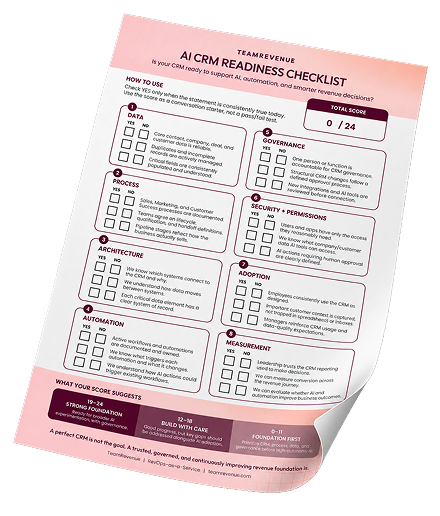
IS YOUR CRM READY FOR AI?
Make sure your CRM foundation is ready. Use the free checklist to uncover gaps before you automate.

Final Thoughts
For years, Revenue Operations has been viewed as the team behind the CRM. The team behind the reports. The team behind the dashboards.
That definition is becoming outdated.
The future of Revenue Operations is much bigger. It sits at the center of how modern organizations grow.
It connects leadership with execution. It aligns people with process. It ensures technology supports strategy. It governs how AI is adopted. It creates accountability. It drives enablement.
Most importantly, it transforms growth from a series of disconnected initiatives into one coordinated operating system.
Because in the age of AI, the companies that win won’t simply have smarter tools. They’ll have smarter systems.
And that’s exactly where Revenue Operations belongs.

WANT THE FULL FRAMEWORK?
Download the free e-book: Driving Business Outcomes with HubSpot. Ten chapters covering the business outcomes every owner should expect from their CRM, from data trust to scaling without breaking.