Many leadership teams believe they are aligned.
They share a revenue target.
They run quarterly planning sessions.
They sit in pipeline reviews together.
On the surface, it feels coordinated. But real Revenue Operations (RevOps) alignment is not an event. It goes much deeper than shared goals or collaborative meetings. It is an engineered system.
When RevOps is truly aligned, the entire revenue engine operates from the same definitions, the same data structure, and the same operating principles. Sales, Marketing, and Customer Success are not just cooperating. They are integrated.
Let’s break down what that actually means in practice.
1. Shared Definitions Create Trust
Alignment begins with language. If Sales and Marketing define a qualified lead differently, performance metrics immediately lose credibility.
Questions to consider:
- What exactly qualifies as a Marketing Qualified Lead (MQL)?
- What criteria must be met for a Sales Qualified Lead (SQL) to be accepted?
- When is an opportunity truly forecastable?
- What constitutes churn or expansion?
If these definitions are unclear or interpreted differently across departments, your dashboards are telling different stories to different people.
Shared definitions are not administrative details. They are the foundation of performance accountability. Without them, reporting becomes subjective.
2. A Unified Data Model Drives Clarity
Your Customer Relationship Management (CRM) system should reflect one cohesive revenue journey, not Marketing’s version. Not Sales’ version. Not Customer Success’s version.
There should only be one lifecycle, one structured data model, one source of truth.
When each department tracks its own version of success inside the same system, alignment breaks down quickly. Silos are simply disguised inside software.
A well-designed RevOps layer ensures:
- Lifecycle stages are standardized.
- Core properties are clearly defined and consistently used.
- Reporting logic is aligned with the actual process design.
- Data flows cleanly from lead to closed deal to renewal and expansion.
Technology does not create alignment. Architecture does.
3. Process Governance Protects Integrity
Stages should mean something. Advancement should require clear exit criteria. Forecast categories should reflect probability, not optimism. And dashboards should mirror reality, not aspiration.
When stages are skipped, redefined frequently, or loosely enforced, trust erodes. Leadership begins to question the numbers. Forecast conversations become debates instead of decisions.
Execution becomes reactive.
Process governance is not about rigidity. It is about consistency. Without governance, every new hire reshapes the system. Over time, small changes compound into structural confusion.
Alignment requires discipline.
4. Cross-Functional Visibility Eliminates Silos
Revenue does not start at opportunity creation. It does not end at a closed won. It is a team effort across the sales funnel. Marketing influences pipeline quality. Sales drives conversion and velocity. Customer Success impacts retention and expansion.
True alignment means:
- Marketing can see how campaigns convert into pipeline and revenue.
- Sales understands where high-performing leads originate.
- Customer Success has context on deal expectations and growth potential.
- Leadership can evaluate the entire revenue lifecycle, not just quarterly bookings.
When each department only sees its slice of the journey, optimization becomes localized and often counterproductive.
RevOps alignment ensures the full system is visible end-to-end.
5. Clear Ownership Makes Alignment Sustainable
Alignment does not maintain itself. Someone must own the system. And it should not come down to “whoever is good at HubSpot”, or the head of Sales, or Marketing, because they use the CRM system more frequently.
RevOps ownership means:
- Governing changes to lifecycle stages and definitions
- Evaluating technology additions before implementation
- Maintaining reporting integrity
- Auditing data hygiene
- Ensuring cross-functional decisions align with the full revenue model
Without clear ownership, alignment slowly deteriorates. Over time, confidence in the system weakens. Leadership relies more on instinct than data. Departments revert to siloed thinking.

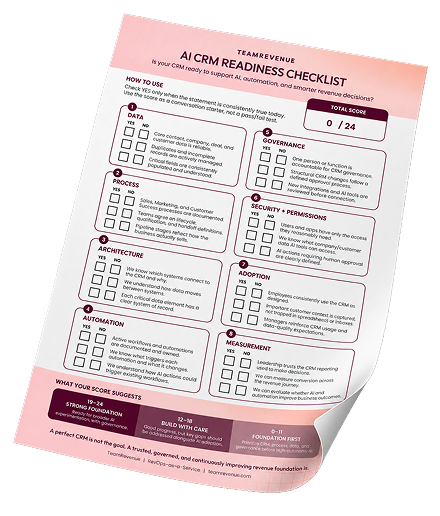
IS YOUR CRM READY FOR AI?
Make sure your CRM foundation is ready. Use the free checklist to uncover gaps before you automate.

Alignment Is a Designed Outcome
RevOps alignment is not accidental. It is not achieved by good intentions or collaboration alone. It is engineered through:
- Shared definitions
- Unified data architecture
- Process governance
- Cross-functional visibility
- Clear ownership
If you stepped back and audited your revenue engine today, would you see one integrated system operating with discipline? Or would you see three well-intentioned departments trying their best inside a loosely connected structure?
Revenue growth becomes predictable when the system is aligned. Without alignment, even strong teams struggle to scale consistently. The question is not whether your teams are working hard. The question is whether your revenue engine is designed to work as one.
Download the complete e-book to continue building clarity, alignment, and leadership insight.