Most businesses do not fail due to poor strategy.
They break because execution starts to fray between teams.
As companies grow, handoffs multiply. Marketing passes over leads to sales. Sales hands over customers to service. Operations supports everyone. Without clear systems, these handoffs create friction, delays, and finger-pointing.
This article focuses on a critical outcome business owners want as they scale:
Teams that stay aligned and execute smoothly without constant intervention from leadership.
This article expands on Chapter 6 of “Driving Business Outcomes with HubSpot: The Business Owner’s Guide to Unlocking the Power of HubSpot”, which demonstrates how workflows and automation minimize breakdowns while maintaining accountability and visibility.
The Outcome Business Owners Actually Want
Business owners want teams that:
- Hand work off cleanly between departments
- Know who owns what and when
- Move fast without creating chaos
- Scale execution without adding unnecessary overhead
When alignment depends on people remembering what to do, execution breaks under pressure.
Why Breakdowns Increase as Companies Grow
Early-stage teams rely on proximity and informal communication. That works until it doesn’t.
As complexity increases, common issues emerge:
- Leads fall through the cracks
- Customers repeat themselves during customer success handoffs
- Internal follow-ups are missed
- Accountability becomes unclear
- Leaders step in to resolve avoidable issues
These are not people problems. They are system design problems.
HubSpot Features That Reduce Execution Breakdowns
HubSpot provides tools that support alignment when they are implemented intentionally.
- Workflows
Workflows automate handoffs, updates, and notifications, ensuring that nothing relies solely on memory. - Cross-Object Automation
Automation across contacts, deals, and tickets ensures information follows the customer, not the department. - Tasks and Notifications
Tasks and alerts maintain clear ownership while ensuring human accountability.
These tools are most effective when they support execution rather than replace judgment.
Common Automation Pitfalls That Create New Problems
Automation done poorly can make misalignment worse.
- Over-Automating Without Visibility
When automation hides what is happening, teams lose trust and control. - Conflicting Workflows
Multiple workflows acting on the same records create unpredictable outcomes. - Automation That Removes Ownership
When no one is clearly responsible, problems still occur, just faster. - No Documentation or Ownership
Undocumented automation becomes fragile as teams and processes change.
These issues often surface only after something breaks.
Best Practices for Scaling Execution with Automation
High-performing organizations follow a few consistent principles.
- Automate Handoffs, Not Judgment Calls
Use automation to ensure work moves forward, not to make decisions that require context. - Keep Humans in the Loop for High-Stakes Steps
Visibility and approval matter when customer impact is high. - Document Workflows and Owners
Clear documentation prevents confusion and supports long-term scalability. - Review Automation Quarterly
As the business evolves, automation must evolve with it.
When these practices are in place, automation becomes a stabilizer instead of a risk.
Why Governance Matters More Than Ever
According to Gartner, by 2027, 80 percent of data and analytics governance initiatives will fail without crisis-driven urgency and outcome alignment.
This highlights a broader issue. Technology alone does not create alignment. Governance and ownership do.
HubSpot supports governance when workflows, permissions, and accountability are designed intentionally.
From Firefighting to Flow
When teams are aligned:
- Execution speeds up
- Customer experience improves
- Leaders spend less time resolving issues
- Growth feels controlled rather than chaotic
When they are not:
- Breakdowns multiply
- Frustration increases
- Leaders become bottlenecks
- Scaling feels painful
HubSpot provides the infrastructure. Intentional automation turns it into leverage.

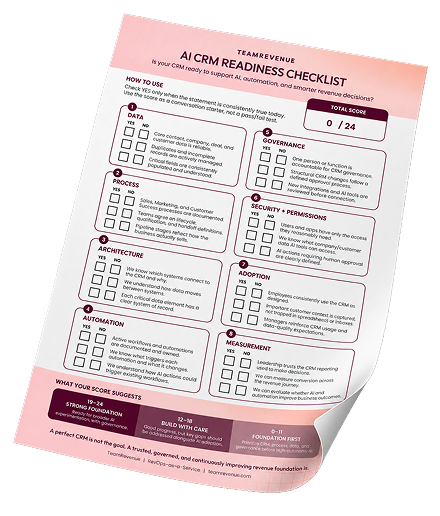
IS YOUR CRM READY FOR AI?
Make sure your CRM foundation is ready. Use the free checklist to uncover gaps before you automate.

Final Thought: Automation Should Support Accountability, Not Replace It
Automation is not about removing people from the process.
It is about freeing teams to focus on meaningful work while ensuring execution stays consistent as complexity increases.
When HubSpot workflows are designed with clarity and ownership in mind, alignment scales naturally.
Want the Full Guide?
This article expands on one chapter from Driving Business Outcomes with HubSpot, a practical guide designed to help business owners scale execution without losing control.
The e-book walks through:
- How to reduce breakdowns as teams grow
- Common automation mistakes to avoid
- Best practices for building scalable, accountable systems in HubSpot
If alignment and execution are becoming more challenging as your business scales, this comprehensive guide will help you transform HubSpot into a system that supports growth without constant firefighting.
Download the complete e-book to continue building clarity, alignment, and scalable execution.