Revenue growth can feel unpredictable when you cannot clearly identify what is driving it.
Many business owners know they are investing in marketing and sales activities, but when asked, ‘What is actually driving our pipeline and revenue right now?’ the answer is often unclear.
Without that clarity, decisions become reactive. Budgets are spread thin. Teams chase activity instead of impact. Growth feels noisy rather than intentional.
This article focuses on how HubSpot helps business owners connect activity to real revenue outcomes so decisions are grounded in evidence, not assumptions.
This article expands on Chapter 3 of “Driving Business Outcomes with HubSpot: The Business Owner’s Guide to Unlocking the Power of HubSpot”, which is designed to help leaders understand what truly influences revenue growth and where to focus their efforts or adjust their approach.
The Outcome Business Owners Actually Want
At its core, this blog is about confidence and focus.
Business owners want:
- Clear visibility into which activities create pipeline
- Confidence in where to invest time and budget
- The ability to stop guessing and start prioritizing
- Alignment between marketing effort and sales outcomes
When HubSpot is structured correctly, it allows leaders to access the information they need without debate or manual analysis.
Why Revenue Feels Unpredictable Without Attribution
In many organizations, activity is measured, but impact is not.
Common symptoms include:
- Marketing reports showing volume, not revenue
- Sales pipelines are growing without clarity on source quality
- Budget decisions based on last quarter’s instincts
- Teams celebrate activity instead of outcomes
This disconnect occurs when systems track engagement but fail to consistently connect it to the pipeline and revenue.
HubSpot Features That Connect Activity to Revenue
HubSpot provides several powerful tools to help leaders understand what is actually driving growth.
- Campaigns
Campaigns enable marketing activities to be grouped under a shared objective, allowing for a holistic view of performance rather than viewing them in isolation. - Attribution Reporting
Attribution reporting connects interactions across the buyer journey to pipeline and revenue, enabling leaders to see influence, not just touchpoints. - Forms and Tracking
Forms, page tracking, and behavioral data provide insight into how prospects engage before entering the pipeline. - Marketing Analytics
Analytics dashboards bring visibility into conversion rates, pipeline contribution, and revenue influence across channels.
These tools are most effective when designed around outcomes rather than volume.
Common Pitfalls That Distort Revenue Insight
Many teams use HubSpot’s tools but still struggle to see impact due to avoidable mistakes.
- Inconsistent Campaign Naming and Structure
Without consistency, reporting becomes fragmented and unreliable. - Tracking Activity but Not Pipeline or Revenue
Measuring clicks and submissions without tying them to deals creates false confidence. - Over-Reliance on Last-Touch Attribution
Last-touch models oversimplify complex buying journeys and skew decision-making. - Measuring Success by Volume Instead of Impact
High activity does not necessarily equate to high contribution. Volume without revenue context leads teams in the wrong direction.
These pitfalls cause leaders to invest more without gaining a deeper understanding.
Best Practices for Understanding Revenue Drivers
Organizations that gain clarity around revenue growth tend to follow a few consistent practices.
- Define Success Before Launch
Before launching a campaign, define what success looks like in business terms, such as pipeline created, revenue influenced, customer acquisition cost, or payback period. - Tie Campaigns to Pipeline Influence
Every meaningful campaign should connect to opportunities and revenue, not just engagement metrics. - Use Attribution to Inform Budget Decisions
Attribution should guide where to invest more and where to stop investing, rather than simply validating past decisions. - Review and Optimize Monthly
Revenue insight improves with regular review. Monthly analysis keeps teams aligned and focused.
When these practices are in place, HubSpot becomes a strategic growth tool rather than a reporting system.
Why This Matters for Modern Leaders
According to Gartner, only 30 percent of Chief Data and Analytics Officers say their top challenge is measuring the impact of data, analytics, and AI on business outcomes.
This highlights a broader issue. Organizations collect more data than ever, yet many still struggle to connect their efforts to outcomes.
Revenue clarity is not about more reports. It is about achieving better alignment between activities, pipelines, and decisions.
From Guesswork to Intentional Growth
When leaders understand what drives revenue:
- Budget decisions become easier
- Teams focus on high-impact work
- Underperforming initiatives are identified quickly
- Growth becomes more repeatable and less stressful
When they do not:
- Effort is spread thin
- Noise increases
- Confidence decreases
- Growth feels accidental instead of intentional
HubSpot provides visibility into growth drivers. Leadership discipline turns it into an advantage.

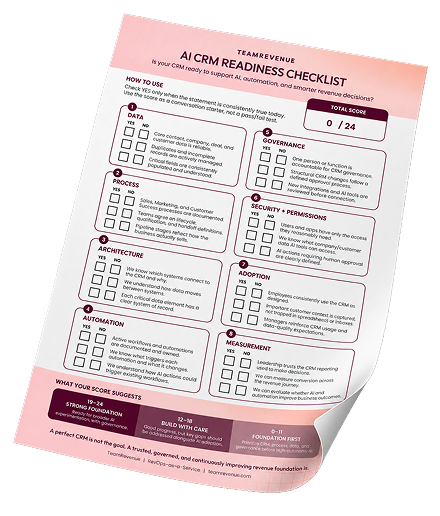
IS YOUR CRM READY FOR AI?
Make sure your CRM foundation is ready. Use the free checklist to uncover gaps before you automate.

Final Thought: Measure What Moves the Business
Activity metrics have a place. Revenue impact must come first.
When HubSpot is configured to connect effort to outcomes, it allows leaders to stop asking “what happened?” and start asking “what should we do next?”.
That shift changes everything.
Want the Full Guide?
This article expands on one chapter from “Driving Business Outcomes with HubSpot,” a practical guide designed for business owners who want clearer visibility into growth drivers and better control over revenue decisions.
The ebook walks through:
- How to connect activity to pipeline and revenue
- Common mistakes that hide true performance
- Best practices for building predictable, intentional growth
If understanding what truly drives revenue is a priority, the full guide will help you turn HubSpot into a decision-making engine rather than a reporting tool.
Download the complete e-book to continue building clarity, focus, and predictable revenue growth.