If Your Team Isn’t Using the CRM, Don’t Blame the CRM
It’s one of the most common complaints I hear from CEOs and sales leaders. “Our sales team just won’t use the CRM.”
The conversation usually starts with frustration directed at the software. “We picked the wrong platform.” “The CRM is too complicated.” “Our team hates updating it.”
But after implementing and optimizing CRM platforms for hundreds of organizations, I’ve come to a different conclusion. CRM adoption rarely fails because of the software. It fails because the organization wasn’t prepared to support it.
Whether you’re using HubSpot, Salesforce, Microsoft Dynamics, or another platform, the technology is rarely the root cause. Instead, poor CRM adoption is usually a symptom of deeper operational challenges:
- Undefined processes
- Inconsistent leadership
- Weak change management
- Lack of enablement
- Overly complex workflows
- Misaligned expectations
The CRM simply makes those problems visible.
CRM Is a Mirror, Not a Magic Solution
Many organizations buy a CRM believing it will improve sales performance. That’s backward.
A CRM doesn’t create discipline. It exposes whether discipline already exists.
Think about it this way. If every salesperson follows a different sales process… Your CRM will reflect inconsistency. If leadership isn’t coaching… Your CRM data will quickly become outdated. If no one agrees on what qualifies an opportunity… Forecasting will always be unreliable.
The CRM isn’t causing these issues. It’s simply documenting them.
That’s why companies using the exact same CRM platform often experience completely different results. The difference isn’t technology. It’s operational maturity.
The Five Biggest Reasons CRM Adoption Fails
1. The Process Was Never Clearly Defined
Technology should support a process. It shouldn’t create one.
One of the first questions I ask new clients is simple: “Can every salesperson describe your sales process exactly the same way?”
More often than not, the answer is no. Some qualify aggressively. Others skip discovery. Some move opportunities too quickly. Others leave deals sitting in the same stage for weeks.
Without consistency, the CRM becomes a collection of personal habits instead of a business operating system.
Before configuring a CRM, define:
- Sales stages
- Exit criteria
- Qualification standards
- Customer handoffs
- Required activities
The software should reinforce the process, not invent it.
2. The CRM Was Designed for Reporting Instead of Selling
This is one of the biggest mistakes organizations make.
Leadership wants visibility. So they ask for more information. Then more. Then even more. Suddenly, every opportunity requires:
- Fifteen required fields
- Multiple dropdowns
- Several custom properties
- Endless task reminders
- Manual updates after every interaction
The result? Salespeople spend more time managing the CRM than managing customers.
Eventually, adoption declines. Not because people dislike CRM software. Because they dislike unnecessary administrative work.
A great CRM should make selling easier. Not harder.
3. Nobody Explained the “Why”
Rolling out a CRM usually includes training. Very few organizations explain why it matters.
Employees hear: “Update the CRM.”
What they don’t hear is: “This helps us forecast accurately.” “This improves customer handoffs.” “This allows us to coach more effectively.” “This helps eliminate duplicate work.”
People support what they understand. When employees see the business value, adoption improves dramatically.
4. Leadership Doesn’t Lead by Example
Culture always starts at the top.
If sales managers maintain their own spreadsheets… If executives ask for updates outside the CRM… If pipeline meetings rely on memory instead of data… Employees quickly learn the system is optional.
Leadership determines adoption. The healthiest organizations use the CRM as the single source of truth.
Every meeting. Every forecast. Every coaching session. Every decision.
When leaders trust the CRM, employees do too.
5. Training Was Treated as the Finish Line
Many CRM implementations follow the same pattern. Implementation. Training. Go live. Project complete.
Unfortunately, that’s where adoption actually begins. Learning software once doesn’t create habits.
People need:
- Reinforcement
- Coaching
- Feedback
- Continuous improvement
- Accountability
CRM adoption is a change management initiative, not an IT project.
The Hidden Cost of Poor CRM Adoption
Most organizations recognize the obvious costs. Poor reporting. Incomplete data. Forecasting challenges.
The hidden costs are much larger.
Poor Customer Experience
Incomplete notes create poor customer handoffs. Customers repeat information. Expectations become inconsistent. Trust declines.
Weak Coaching
Managers coach from incomplete information. Instead of improving behavior, conversations become guesswork.
AI Produces Poor Results
As organizations introduce AI into CRM workflows, data quality becomes even more important. Poor data creates poor AI.
Garbage in. Garbage out.
The future of AI depends on the quality of today’s CRM adoption.
Slower Decision Making
Leadership loses confidence in reporting. Meetings become debates instead of discussions. Everyone brings their own spreadsheet.
Now the organization has multiple versions of the truth. That’s incredibly expensive.
What High-Performing Companies Do Differently
The best Revenue Operations teams don’t start with software. They start with simplicity.
They ask questions like: What information actually helps salespeople sell? What information helps leaders make decisions? Which fields are essential? Which workflows remove friction? Which automations genuinely save time?
Notice what’s missing. No one asks: “What else can we make mandatory?”
Simple systems outperform complicated systems almost every time.
Think Like a Salesperson
One of the best exercises you can do is sit beside a salesperson for an afternoon. Watch how they work. Notice where frustration appears.
Where do they click too many times? Which fields feel unnecessary? Which tasks add no value?
The people closest to the customer often provide the best operational insights. CRM design should support how people actually work, not how leadership imagines they work.
Revenue Operations Makes CRM Valuable
This is where Revenue Operations changes the conversation. Many organizations think RevOps owns the CRM. I don’t.
I believe RevOps owns the operating system behind the CRM.
Revenue Operations aligns:
- Leadership
- Marketing
- Sales
- Customer Success
- Process
- Technology
- Data
- Enablement
- Accountability
The CRM becomes one component inside a much larger system. When that operating system is healthy, CRM adoption becomes much easier because people understand how the platform supports the way they work.
Three Questions Every CEO Should Ask
Before investing in another CRM project, ask yourself:
Does our CRM make selling easier?
If not, simplify it.
Would a new salesperson understand our process within thirty days?
If not, document it better.
Do our leaders consistently use CRM data to make decisions?
If not, adoption will always struggle.
Leadership creates habits. Technology simply reinforces them.

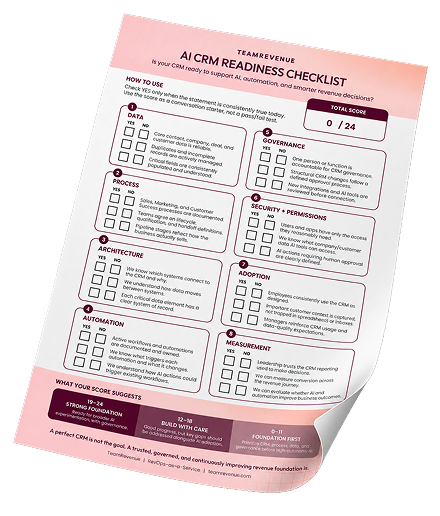
IS YOUR CRM READY FOR AI?
Make sure your CRM foundation is ready. Use the free checklist to uncover gaps before you automate.

Final Thoughts
CRM adoption isn’t a software problem. It’s a leadership problem. It’s a process problem. It’s an enablement problem. Most importantly, it’s an operational problem.
The organizations that achieve exceptional CRM adoption don’t necessarily buy better technology. They build better systems.
When process is clear… When leadership is aligned… When enablement is continuous… When accountability becomes part of the culture… The CRM stops feeling like administrative work.
It becomes one of the most valuable assets in the business.
Because at its best, a CRM isn’t just a database. It’s the operational heartbeat of your revenue engine.

WANT THE FULL FRAMEWORK?
Download the free e-book: Driving Business Outcomes with HubSpot. Ten chapters covering the business outcomes every owner should expect from their CRM, from data trust to scaling without breaking.